

Traditionally, bookstores have a big sale at this time of year, with a number of books going on sale at low prices. This year's Mammoth Sale runs from February 20 to March 5.
Mammutsalget is a Norwegian book sale event with a long and rich history. The first joint price reduction took place as early as 1885. In the 1900s, it was usually the publishers who held their own price reductions, with the exception of two joint initiatives under the name «Det store røverkjøpet». This was a book sale event where publishers worked together to sell large quantities of books at reduced prices.
After the end of the war in 1945, a major price reduction of more than 1,400 titles was organized, laying the foundation for what would later become the Mammut sale. In 1964, the Mammut name was launched and the Publishers' Association and the Booksellers' Association took over. This was a major change from previous reductions, where the publishers had been responsible for arranging the sale.
Below, we've picked out a few books that we think might be particularly exciting for genealogists from this year's edition of Mammutsalget.
The liquidation; the story of the Holocaust in Norway and the hunt for Jewish property

Who carried out the Holocaust in Norway? The Holocaust in Norway consisted of two liquidation processes: one economic and one physical. The economic liquidation meant that everything the Jews owned was confiscated by the occupying regime. The assets were to be converted into pure money, which would then go to the state. The physical liquidation meant arrests, deportations and murders of the Jewish population in Norway. These processes were inextricably linked, but until now, representations of the Holocaust in Norway have focused on the physical persecution. In The Liquidation, Synne Corell tells the story of the Norwegian Holocaust anew, using the economic persecution as a point of departure. The result is a completely new account of one of the darkest chapters in Norwegian history. In The Liquidation, we follow the people who planned, participated in and carried out the atrocities against the Jews in Norway, and we see in detail what they did. We also get close to the families and individuals who became victims of these acts. Corell shows how the liquidation was a carefully planned action that unfolded on many levels and in many places simultaneously, involving large parts of Norwegian society: from public institutions, banks and business companies down to auction customers, neighbors and partners. New sources and analysis provide a different timeline for the persecution process, and a new understanding of what the Norwegian Holocaust really was.
The Lords sent us here; about the forced relocation of the Sami

Winner of the Swedish August Prize 2020. In 1919, Norway and Sweden agree to limit the amount of reindeer that can be moved across the border; the Norwegian state wants the outlying land for its own. This initiates the relocation of a large number of Sami families with reindeer herds. The authorities call the solution a dislocation, in Sami the word bággojohtin, forced relocation, is born. The nomadic Sami who have so far lived in Sweden in the winter and Norway in the summer are no longer allowed to return to Norway. Instead, they are placed in various locations in Sweden. The first to be forced to leave leave their homes in the belief that they will be allowed to return. Sami Elin Anna Labba, who comes from a family that was relocated in the 1920s, now tells the story as seen through the eyes of the forcibly relocated. The text is based on almost a hundred interviews with forcibly relocated Sami people in Sweden. Labba has gathered stories, photos, letters and jokes, and conjures up a chorus of voices from those who can no longer speak. The book depicts hard lives, large reindeer herds that are lost, children who are left to relatives in Norway and who do not see their families for many years. Labba brings to life the grief over the loss of the Norwegian seaside and, not least, the deep respect for and love of nature.
Where did it all go? The looting of the Jews in Norway

From the inside of the first Holocaust settlement. The Holocaust was also a story about possessions, property and finances. At the same time as the arrests of male Jews in October 1942, policemen around the country seized valuables from Jewish homes: jewelry, watches, silverware and cash. Houses and apartments, factories and businesses were transferred to the benefit of the state. After the deportation, belongings and contents were sold at auction to neighbors and other interested parties. When the surviving Jews returned home in 1945, little was left of everything they had owned. For many of the survivors, the struggle against bureaucracy, harassment and suspicion in the compensation process was a new traumatic experience. In 1996, the government appointed a committee to look at the issue again. When the Skarpnes Committee's report was presented the following year, the majority's conclusion was clear: All Norwegians had suffered losses during the war, and the compensation process had been «good and thorough». The majority included several prominent historians and lawyers. Berit Reisel and Bjarte Bruland took a different view: The looting of the Norwegian Jews had to be seen in the context of the Nazis« attempt to exterminate the Jewish population in Norway. What had actually happened to the Norwegian Jews and their possessions had to be mapped anew. The minority's approach led to a different conclusion. The committee was split. When the Norwegian Parliament decided in the summer of 1998 to award the Jews of Norway NOK 450 million in compensation, it was the recommendation of the minority that was used as a basis. In retrospect, the Skarpnes Commission represents an important turning point in Norwegian post-war history. Now, for the first time, this dramatic story is told from the inside. »Where did it all go wrong?" is a sensational account of political gamesmanship and tug-of-war, of prejudice and reluctance both in the bureaucracy and the academic community - and of a small minority who managed to turn around a heavy, prestige-laden process. At the same time, it is a personal story about the experiences of the Jewish minority.
On high heels in America; young Agder women in post-war New York

Why did unmarried Agder women go to New York in the years 1946-1965? What were they looking for and what did they find in America? They came from the pietistic Southern Norway. In the new country, they found paid work, but also a completely new life. But the immigrant women adapted to new norms. «Everyone was affected by the American style,» as one of them said. They became modern women. In America, the southern women changed their style and way of life. They wore lipstick, got perms and had their hair cut short. They shaved their legs and wore nylon stockings and high-heeled shoes. They worked in offices, smoked cigarettes and went to the movies. They lived with a metropolitan pulse, department stores and electrical products. They had a different view of the body, religion and life expression. On high heels in America, the women experienced a new form of independence - and freedom. Most of them returned home to Norway, taking their customs with them. Not only had they themselves been transformed, they also transformed Norwegian society forever.
Norway stone by stone: the story of our fortresses
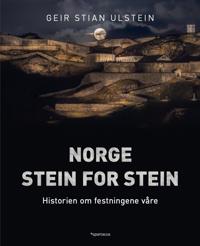
Once upon a time, a king ordered a defense to be built here, and based on principles taken from the world outside Norway, it was built to defend city and country. Those who ordered, planned and carried out the work are gone. And now the things that should have defended them will soon be gone too. Norwegian fortifications are at the mercy of nature, but history lies there, under branches and tufts of grass. The Norwegian fortifications were central to the development of our nation as we know it today. Many of the fortifications are now heavily neglected, but have borne decisive moments in our past. With text and photos, the book documents the fortifications as they were, as they are and the history they carry. Norway Stone by Stone is a rich, visual journey into architecture, craftsmanship, daily life and acts of war, providing a unique insight into the building of Norway. The selection has a wide geographical spread, from Vardøhus in the northeast to Christiansholm in the south, Bergenshus in the west and Kongsvinger Fortress in the east. The new photographs were taken by Tor Simen Ulstein.
The myth of the walled city; Christiania 1624-1814

On the night of August 17, 1624, Oslo was hit by a fire that raged for three days and left almost the entire city desolate. Only the church, some brick buildings and foundations remained among the charred remains of wooden houses. At least 14 times the city had been completely or partially burned down. The fire of 1624 was the most significant event in Oslo's history. King Christian IV therefore decided that Oslo should be moved to the opposite side of Bjørvika and renamed Christiania. At the same time, he introduced a wall ban to prevent further fires. Lofting, which was the usual method of construction, was banned. But did Christiania become a walled city? The king knew that brick houses were expensive to build for most people, so he allowed timber framing with brickwork. But the construction method was little known, and it was unfamiliar to Norwegian carpenters. Foreign carpenters and bricklayers had to build the first houses. A mixture of domestic lath and foreign timber became the city's building style. At the same time, the city became more international. «The few brick houses we protect as cultural monuments are not representative of the buildings in »Old Christiania'," writes Roede. They belonged to the city's upper class. There are no houses for the general public left in the city center. In this book, Roede attempts to paint a picture of the lost buildings. What did they look like, the houses that ordinary citizens lived in? Why was the cityscape completely different from that of the Norwegian wooden towns?
