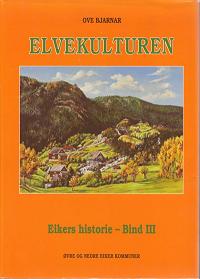
Volume III, “Elvekulturen” (The River Culture) depicts an early modern rural community with an emphasis on the 18th century until Eiker was divided in 1885. The author describes a dynamic local community that developed striking economic and social adaptability and maneuverability throughout the period. The book is a work of local history that provides new knowledge about Eiker's history, elaborates on important aspects of our national history, and contains elements of comparative material that frames Eiker as a community that experienced an early form of modernization.
Contents
PART II
THE VILLAGE BOOK COMMITTEE'S FOREWORD
| s. 7
|
AUTHOR'S FOREWORD
| s. 8 |
| TIME TABLE | s. 10
|
| | |
PART I | |
| The small ham shift in the farming community of Eiker (1616-1815) | s. 13 |
| Introduction | s. 15 |
| SPOKES ANNO 1784 | s. 16
|
| The river people | s. 20 |
| The power of money for rich and poor | s. 32 |
| An ordinary man | s. 43 |
| THE PEASANTS MEET NEW DEMANDS IN THE WOOD INDUSTRY (1616-1680s) | s. 53
|
| Eiker - a county where timber dominated | s. 61 |
| King, farmer, citizen | s. 70 |
THE OAK FARMERS DEFEND THE TRADE IN BEAMS (1680-1750s)
| s. 84
|
| A community around the Kverk hinge | s. 87 |
| Times of crisis | s. 111 |
OATS AND HORSES - FROM AGRICULTURAL ECONOMY TO PEASANT ECONOMY (1720-1800)
| s. 116
|
| Oats and horses | s. 118 |
| Farm economy in the valley of the horse | s. 138 |
| So many kinds of househusbands | s. 160 |
| Farmer economy and ability to adapt | s. 172 |
AN EARLY-MODERN LOCAL COMMUNITY IN DANISH PLANNED ECONOMY (ca. 1740-1815)
| s. 179 |
| The early modern society | s. 183 |
| National economy, business economy and farmer economy at Eiker | s. 204 |
| Independent Eiker women | s. 235 |
| Social structure and literacy | s. 243 |
| Time for change | s. 254 |
PART II | |
| River culture - traditional and dynamic (1815-ca. 1885) | s. 269 |
| Introduction | s. 271 |
PEOPLE AND LOCAL COMMUNITIES IN MOTION (1815-ca. 1885)
| s. 273
|
| A divided but also expanded community | s. 275 |
| Is the balance shifting? | s. 294 |
| From population explosion to youth exodus | s. 309 |
| An adaptable river culture? | s. 322 |
| LESS OATS, MORE HAY: A NEW WAY OF FARMING (ca. 1815-1880s) | s. 33
|
| Technique, mindset change and technology | s. 338 |
AN INDUSTRIAL EVOLUTION IN THE 19TH CENTURY
| s. 338
|
| The second act in the industrialization of Eiker (ca. 1815-ca. 1875): | |
| The local dimension | s. 376 |
| Third act of industrialization (from the 1870s): Establishment wave with roots in local industrial environment | s. 413 |
| The Norwegian community in Eiker | s. 423 |