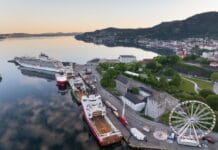

Sjøbad II is Oslo's oldest floating cultural monument, with more than 100 years of service in the harbor basin. Now the vessel is being protected by the National Heritage Board.
The bathing ferry was built for the municipality of Oslo, and from 1923 it transported happy bathers to Hovedøya and Langøyene for over 60 years. Many people have fond memories of trips on Sjøbad II, and it is therefore an important historical source of Oslo's leisure culture and maritime history.
- Norway is, and has been for hundreds of years, a coastal nation. By preserving boats like Sjøbad II, we are preserving the history of how we have lived and developed our society," says Andreas Bjelland Eriksen, Minister of Climate and Environment. "We can all be proud that boats like Sjøbad II are still in active use and so well preserved. The owners and volunteers make an invaluable contribution," says Eriksen.
The preservation also emphasizes the national cultural heritage value of recreational life along the coast:
- "Sjøbad II is an important part of Oslo's harbor environment, and is still located on its permanent berth for 100 years," says Hanna Geiran, Director of Antiquities.
- It is very well preserved and tells us how important leisure time has always been for the cultural heritage and history of the coast, not only in Oslo, but also in a national perspective.
«Sjøbad II» has transported a very large number of passengers, which also reflected a cross-section of the population from all over the city. The ship has been owned by Preco AS for 40 years, ever since the municipality sold the ship, and then Sjøbad II has been in regular passenger traffic between the port of Oslo and Dyna lighthouse since 1992. The preservation is intended to preserve Sjøbad II as the vessel appeared in 1983, which was the last year Oslo Municipality had the vessel in regular service.
- "We have taken good care of Sjøbad II throughout the years," says Tom Preststulen, owner of Preco, "because we believe it has been important to preserve the maritime history of the inner Oslofjord. Today, we mainly use Sjøbad II to transport guests to and from Dyna Lighthouse.
In 1982, the Norwegian Maritime Museum (now the Maritime Museum) designated the ship as particularly worthy of preservation, and in 2007 Sjøbad II was awarded the status of protected ship by the National Heritage Board. It is the first “genuine Oslo vessel” to be protected, while the ships DS Børøysund and MS Nordstjernen have also been given Oslo as their home port after long and faithful service in other coastal areas.
A real Oslofjord vessel in traffic to Dyna Lighthouse
Sjøbad II is closely linked to the blossoming of the bathing culture at the beginning of the 20th century, and was commissioned by Kristiania Kommunale Bad and built by C. Løvaas Motorbåtbyggeri in Drøbak. It is a particularly good representative of the many vessels that transported passengers between cities and outdoor areas close to the city.
When the capital opened a municipally run open-air bath on Hovedøya in 1914, the crossing to the island was also free through a newly established municipal ferry company. Oslo was alone in Norway with the concept of a free municipal bathing ferry, which became a popular initiative.
- The Oslofjord, with its islands and sea baths, was and is part of the capital's soul and identity. For many of us, it is perhaps the city's most beautiful recreational area," says Anne Lindboe, Mayor of Oslo.
- At a time of great social differences and overcrowding, «Sjøbad II» gave the entire population the opportunity to enjoy nature and bathing by the fjord. By preserving «Sjøbad II», we are preserving a unique part of Oslo's history, at the same time as the boat will continue to be used for the benefit of Oslo's residents," continues the mayor.
The design of Sjøbad II is clearly inspired by the architecture of the functional swimming pools in the inner Oslofjord, and emphasizes the purpose for which it was built. This makes Sjøbad II a unique representative of both design expression and use.
Facts about the conservation of Sjøbad II
The »Sjøbad II" is a wooden flat-decker built in 1923. The preservation includes the entire vessel with permanent fixtures and fittings, such as fixed equipment and furnishings like benches, bollards, wall-mounted folding chairs, lanterns and lanterns and the like, as well as the skipper's chair in the wheelhouse. The fact that the vessel is listed shall not prevent its use.
The hull is symmetrically designed, and until 1952 was a pendulum ferry with a propeller and rudder at both ends. After the first engine change in 1952, the bathing ferry was rebuilt with a «false stern» and a propeller and rudder at one end. Originally, the wheelhouse, deckhouse and partition between the decks were centered in the middle. This was changed in 1970, when «Sjøbad I» last had an engine change. The preservation documentation has more detailed descriptions of the changes.
The vessel was completely restored between 2015 and 2023. The restoration was carried out in close collaboration with both the National Heritage Board and the county council. Throughout the restoration process, Sjøbad II has been well documented through photos, archives, interviews, close cooperation with Promhavn Slipp AS and the owner, and it was also 3-D scanned by Nordnorsk Fartøyvernsenter in 2015.
On behalf of Oslo Municipality, Akershus County Council is the host municipality for vessel protection. This means that Akershus County Council is responsible for the management of listed vessels with a home port in Oslo Municipality. The county council also answers questions about preservation and processes applications for exemptions and grants.